
Is a Fire Alarm a Legal Requirement?
For almost every business premises in England and Wales the answer is yes in practice: the law requires fire detection and warning that matches your fire risk assessment, kept in working order.
- Plain answers on the law
- BS 5839-1 and BS 5266-1
- Certificates on the day
Request a call back
Name and number are all we need to arrange a call back and a free survey.
- SSAIB approved for intruder alarmsFor intruder alarms
- BS 5839 fire alarmsCertificated every visit
- Since 2001Family-run in SW17
- 20+ five-starGoogle reviews
What it costs
Servicing
- Fire alarm from £180 + VAT a visit
- Emergency lighting £150 + VAT
New systems
- Fire alarm from £1,200 + VAT
- Smoke alarms from £230 + VAT
A free site survey comes first, then a fixed written quotation. Larger buildings are priced per device.
What the Fire Safety Order actually says
The Regulatory Reform (Fire Safety) Order 2005 does not name a panel or a standard for every building. It makes the responsible person provide a means of detecting fire and raising the alarm where the fire risk assessment calls for it, and almost every workplace, block or public building needs one.
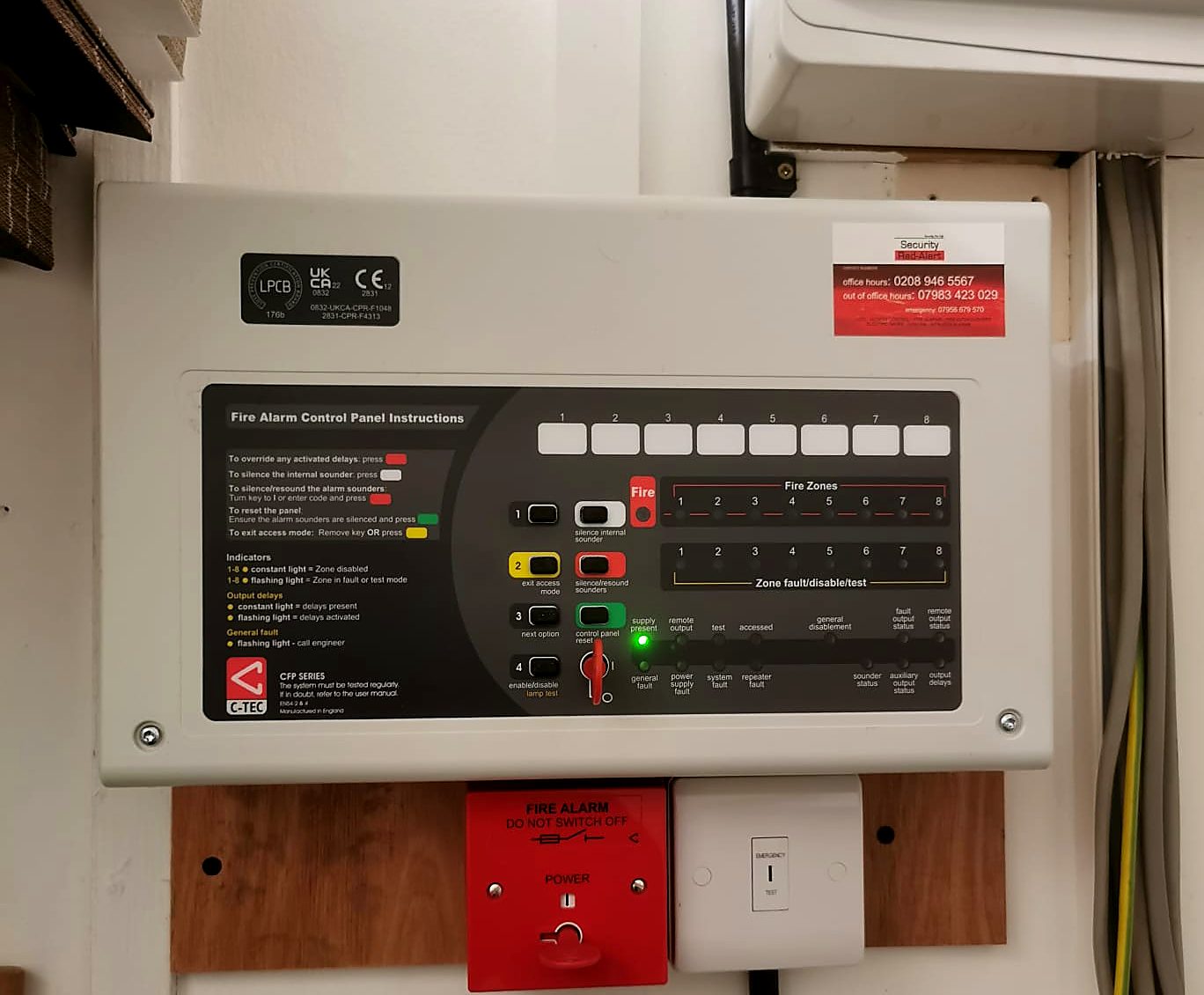
Just as important, article 17 of the Order requires fire safety systems to be maintained in efficient working order and good repair. That is why servicing is not optional: an alarm that has not been maintained can put the responsible person in breach even though a system is fitted. BS 5839-1, the British Standard fire alarm systems are designed and serviced to, recommends a service visit at least every six months, and the certificate from each visit is what your insurer, your landlord and the fire officer ask to see.
What the law expects of a business
- A fire risk assessment that says how fire will be detected and people warned
- A fire detection and alarm system that matches that assessment
- The system maintained in efficient working order (article 17)
- Regular servicing by a competent person, six-monthly under BS 5839-1
- Emergency lighting on escape routes where the assessment requires it
- Records and certificates available for the fire officer and insurer
What you get from working with us
A Straight Answer
We tell you what your building actually needs under the Order and the standards, and what it does not.
Certificates on the Day
Every service visit ends with the certificate your insurer and fire risk assessment rely on.
Six-Monthly Schedule
We remind you before each service is due, so the system never drifts out of date.
Emergency Lighting Too
The annual BS 5266-1 test is done on the same visit, one engineer and one certificate pack.
Who is the responsible person?
In a workplace it is usually the employer; in a block of flats the landlord or managing agent; in shared buildings each occupier for their own part. The responsible person can be prosecuted personally if fire precautions are neglected, and after a fire the first things investigators ask for are the fire risk assessment and the service records.
If you are not sure who holds the duty in your building, that is worth settling now rather than after an inspection. We can look at what is fitted, what the assessment says and whether the paperwork is in order, in one free survey visit.
What happens if you do nothing
Fire and rescue authorities inspect premises and can issue enforcement and prohibition notices; serious breaches carry unlimited fines and, in the worst cases, imprisonment. Insurers also rely on the servicing record: after a claim they ask for the certificates, and a missed service is an uncomfortable conversation at the worst possible time.
Frequently Asked Questions
Does every business legally need a fire alarm?
The law requires a way of detecting fire and warning people that matches your fire risk assessment. In a very small, open single-space premises that can occasionally be met without an electrical system, but for almost every shop, office, restaurant, warehouse or block the assessment calls for a proper fire alarm to BS 5839-1.
Is fire alarm servicing a legal requirement?
Article 17 of the Fire Safety Order requires fire safety systems to be maintained in efficient working order. BS 5839-1 recommends service visits at least every six months, and that is what fire officers and insurers expect to see evidenced.
Is emergency lighting a legal requirement too?
Escape routes must be able to be used safely if the lighting fails, so emergency lighting is required wherever the risk assessment calls for it, which covers most business premises. BS 5266-1 recommends an annual full-duration test with a certificate.
What certificates should we hold?
The commissioning certificate from when the system was installed, and a servicing certificate from each maintenance visit. Licensing officers, building control, insurers and managing agents all ask for them.
We rent our premises. Is this our problem or the landlord's?
Usually both, split by the lease: the landlord often owns the base-build systems and the occupier the day-to-day compliance of their own space. We work for both and can tell you where the line usually sits.
Get compliant, starting with a free survey
Tell us about the building and we will call you back to book a free, no-obligation survey. You get a fixed written quote after every visit.
- Plain answers on the law
- BS 5839-1 and BS 5266-1
- Certificates on the day
Phone answered 24/7